
President’s Letter 2026: Towards a Shared Agenda
As we enter our 40th year, Mediators Foundation aims to be a home for transpartisanship.
As Mediators’ new president, I am grateful for the opportunity to build on four decades of work advancing communities that bridge across differences, collaboratively develop solutions, and coordinate action.
Throughout my career, I have stood for these tools to counter confusion, callousness, and cynicism that weaken democracy. I’ve worked at the local and state levels alongside people with very different worldviews—conservative ranchers and developers, and progressive environmentalists and homeless shelter operators; fiscal hawks and social justice advocates; members of the Tea Party, MAGA-aligned organizers, and those deeply skeptical of both.
In all of these efforts, my aim has been the same: to improve the lives of people from all walks of life, now and into the future.
What drives me is sustained, scaled transpartisan impact.
But what does transpartisan “impact” mean in this current political moment—one defined not only by polarization, but also deep distrust, rapid institutional change, and a widespread struggle to address the kitchen-table challenges people face every day? And what kind of sustained impact should Mediators Foundation, the suite of projects it hosts, and the broader field be striving toward?
At Mediators, transpartisan does not simply mean nonpartisan or cross-partisan. It means above partisanship—seeking to elevate the shared values, policies, and visions that must exist to support all Americans, regardless of ideology. This does not mean neutrality, and it definitely is not passive. Rather, it reflects a deep commitment to a different way of doing civic and political life: one grounded in care for people and places, respect for differing perspectives, and the belief that durable solutions that uplift everyone only emerge when all of those varying perspectives are meaningfully engaged. This is the higher ground we seek.
Two years ago, many leading thinkers on democracy including Mediators’ founder, board chair, and former president, Mark Gerzon, raised a red flag about the weakening of our constitutional democracy. Since then, polarization has intensified, manifesting in political violence, unprecedented threats against elected officials across the spectrum, rising tensions around immigration enforcement and community safety, uncertain economic outlook, and growing distrust in institutions at home and abroad. Regardless of where one stands on specific policies, the collateral damage to trust, social cohesion, and even life is real. It is hard to shake the sense that our society is getting more callous, confused, and cynical. Dynamics on the left, right, and center alike too often reward outrage, oversimplify complexity, and punish cooperation—deepening divides rather than addressing shared challenges.
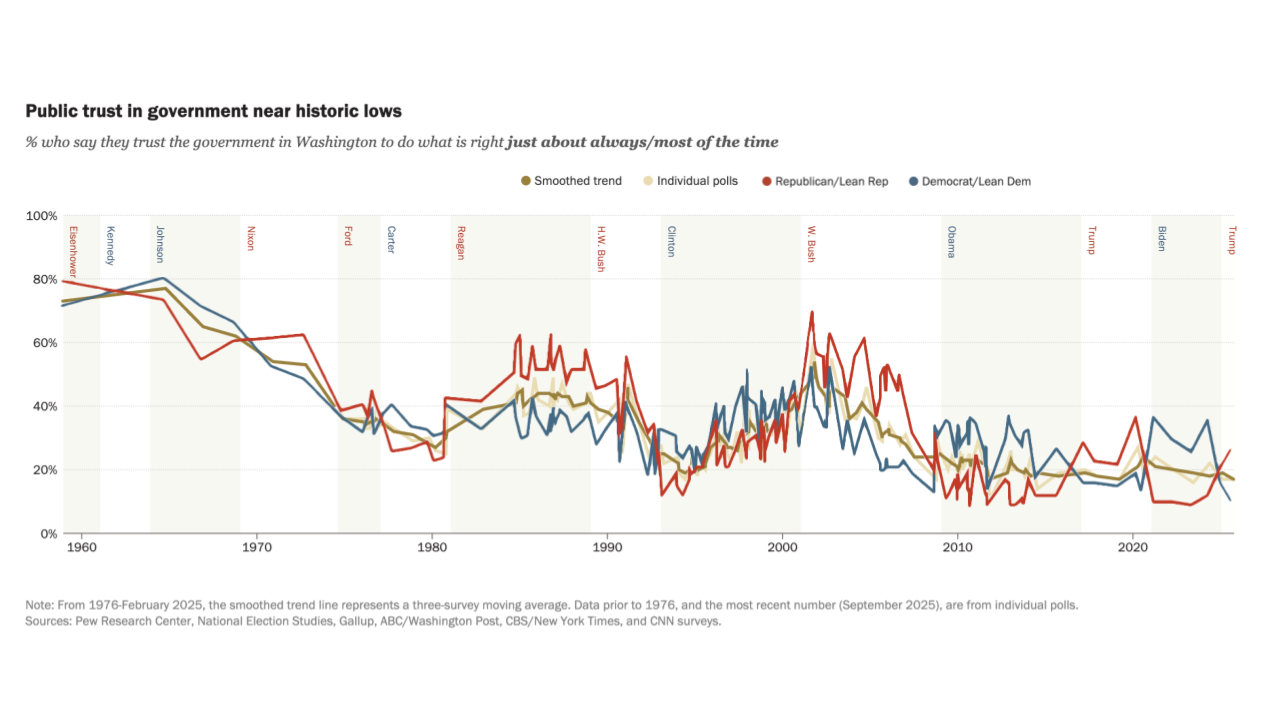
Unsurprisingly, trust in government remains abysmally low. Only 17 percent of Americans say they trust the federal government to do what is right just about always or most of the time—a figure that has remained stubbornly low for years. Even among those whose preferred party currently holds power, trust is only at 26% (See chart, Pew Research Center, 2025).
Against this backdrop, Mediators Foundation is home to a diverse portfolio of more than 30 initiatives working in living rooms, classrooms, local communities, and national arenas to strengthen democracy and the civic fabric. They are a microcosm of what we call the civic ecosystem. Our projects work to change narratives, expand civic education, build social cohesion, advance service, bridge divides, solve problems collaboratively, and take action that builds resilience and supports healthier democratic systems. They engage technology and media, youth and Indigenous communities, local leaders and national networks, immigrants and legal experts. Together with the thousands of other groups and organizations in the civic ecosystem, we have the potential to build a true system of care for civic health in our communities, states, and country (see image).
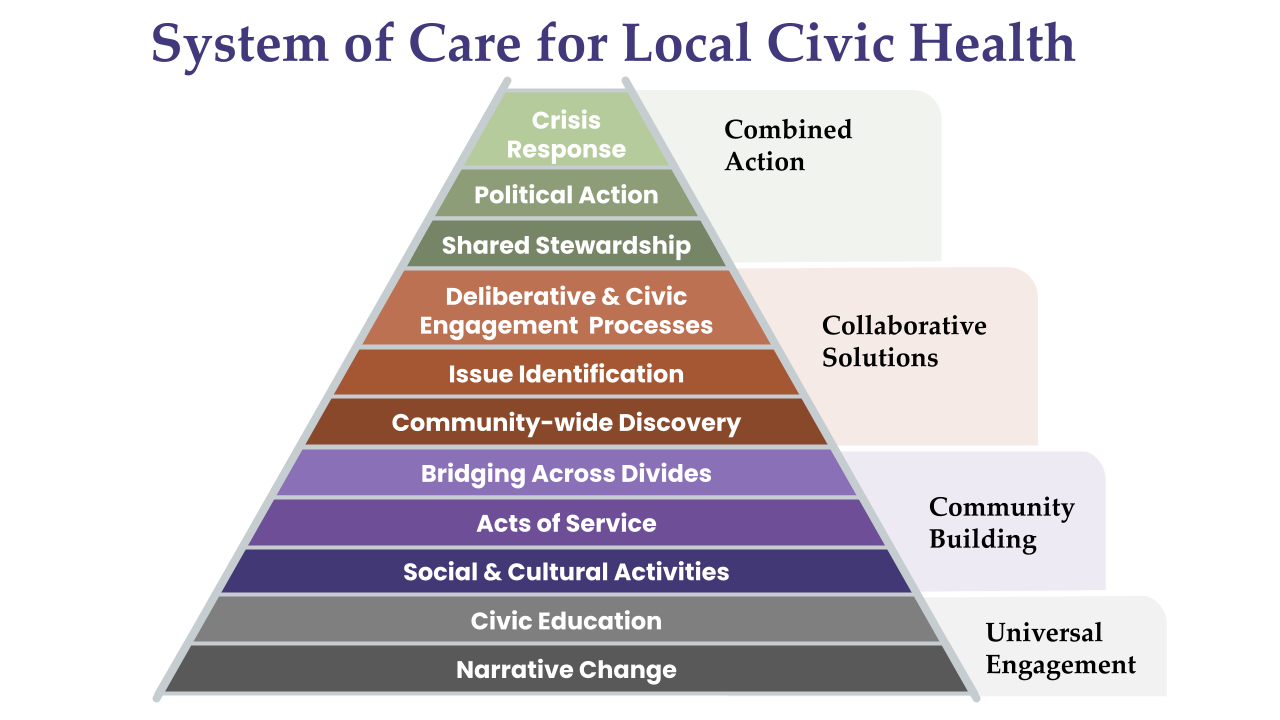
Civic Health System of Care. Developed by Vinay Orekondy and Jacob Bornstein.
Below is a snapshot of how our projects align with these shared aims.
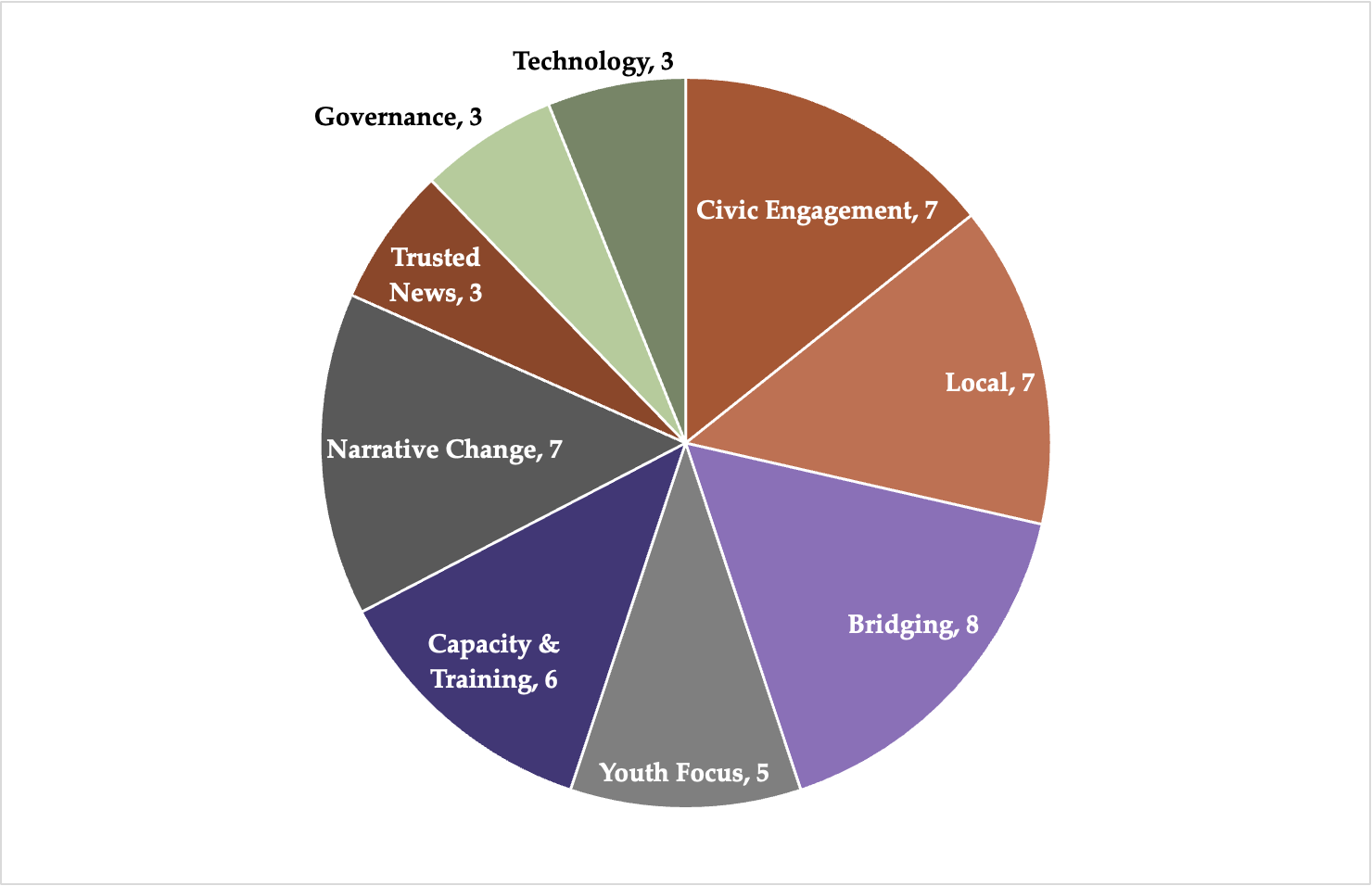
Mediators Foundation Projects by Category 2026.
For the collaborative, field-building initiatives Mediators has proactively shepherded, the growth has been encouraging. Better Together America now supports dozens of Civic Hubs across the country, achieving fourfold growth in 2025 and strengthening community resilience by tapping into civic infrastructure that already exists (BTA’s Impact Report is forthcoming). The Civic Exchange, our peer-to-peer fundraising platform, completed its initial pilot, enabling several organizations to raise new funding sources for this work. These are important steps to advance Mediators’ mission of strengthening the connections in the field for lasting, meaningful impact.
At the same time, I find myself asking a deeper question. If Mediators Foundation is dedicated to creating a more cohesive and impactful field—and to offering a positive vision for this moment, defined not only by polarization and a weakening democracy but by our collective difficulty in addressing fundamental challenges—what is the field’s common agenda?
Let’s be honest: we cannot go back, and we should not spend much time mourning the past. The old systems failed many millions of Americans who felt they did not belong, who faced intergenerational poverty, community violence, addiction, or suicide, and who experienced government as perpetually gridlocked or dysfunctional. Those realities did not begin recently, and they continue to shape lives today. We must move through this moment and step forward.
So, I want to ask the question another way: What should our shared agenda be if we truly believed every American mattered equally? If we had a dollar for every American to invest over the next few years—roughly $350 million—what would we prioritize to bring about a new wave of trust, resilience in the face of our growing crises, the belief that we as Americans are better together than we are apart, and the opportunity for everyone to thrive?
With a commitment to transpartisanship, strengthened democracy, and a belief that every voice matters, I invite you to share your perspective by completing this short form. We will synthesize and share what we learn as part of our 40th anniversary reflections. Please feel free to pass on the invitation with colleagues and friends.
May we continue the work of building a more connected, capable, and caring civic ecosystem—together. By coming together, we can create change that lasts for generations and transforms our communities and nation into a place where all people thrive.
In partnership,
Jacob Bornstein
President,
Mediators Foundation
